Abstract
Ensuring the reliability and robustness of power testing equipment is crucial in today’s rapidly evolving industrial landscape. The IEC 61000-4 series of standards, including IEC 61000-4-11 and IEC 61000-4-34, provide detailed guidelines for evaluating the performance of electrical and electronic equipment when subjected to voltage dips, interruptions, and other transient disturbances. This article explores the technical requirements and challenges associated with compliance testing, highlights the advanced role of Electronic Power Transfer Switch (EPTS) systems, and discusses how InfiniPower’s testing equipment meets these rigorous standards. In addition, references to proven studies and regulatory documentation are provided to support the discussion.
Introduction
Modern power testing equipment must meet increasingly stringent electromagnetic compatibility (EMC) and immunity standards. In an environment where fast transient disturbances and voltage fluctuations are common, compliance with international standards like IEC 61000-4-11 and IEC 61000-4-34 is essential. For companies like InfiniPower, which design and manufacture cutting-edge power testing equipment, achieving compliance is not just a regulatory necessity but a competitive differentiator.
IEC 61000-4 standards provide the technical foundation for testing electrical equipment’s robustness against disturbances such as AC voltage dips and interruptions. This article delves into the technical requirements outlined in these standards, explains the importance of testing under realistic conditions, and discusses how InfiniPower’s innovative solutions, such as the Electronic Power Transfer Switch (EPTS), help meet these challenges.
Background on IEC 61000-4 Standards
IEC 61000-4-11: AC Voltage Dips and Interruptions
IEC 61000-4-11 is a widely recognized standard that sets the test methods and procedures for simulating AC voltage dips and interruptions. The primary goal is to evaluate the immunity of electrical and electronic equipment when exposed to disturbances that can occur in the mains supply. The standard defines the transient conditions (both voltage dip and interruption scenarios) that the equipment must endure without malfunctioning.
A key component of IEC 61000-4-11 is its emphasis on replicating realistic transient conditions. For example, Table 1 below illustrates the differences in specifications between IEC 61000-4-11 and IEC 61000-4-34 regarding voltage rise and fall times, load conditions, and application focus.
IEC 61000-4-34: Transient Overvoltages
IEC 61000-4-34, while closely related to IEC 61000-4-11, deals specifically with transient overvoltages and interruptions in AC power systems. It addresses the necessary transient characteristics for equipment that may have different power ratings. For equipment with power ratings below 75A per phase, the requirements for the voltage rise and fall times are similar to those in IEC 61000-4-11. For higher power equipment, the standard allows for extended times – up to 50 μs – for full compliance testing.
Both standards are crucial for ensuring that equipment can survive unexpected transient events, which may be caused by both public network disturbances and local failures. They provide a structured methodology to simulate and measure how power systems respond during such events.
Technical Requirements and Rationale
Voltage Rise and Fall Time Specifications
One of the central technical requirements of IEC 61000-4-11 is the control of voltage transition times. According to the standard, the voltage rise (tr) and fall (tf) times during an abrupt change must be between 1 μs and 5 μs when the generator is loaded with a 100 Ω resistive load. This specification is crucial because:
-
Simulating Realistic Conditions: In the event of a local short circuit, voltage levels may drop to zero within microseconds. Equipment designed for natural line commutation (typically in the millisecond range) faces severe stress when subjected to these fast transitions.
-
Impact on Electronic Components: The sudden high reverse voltage during rapid transitions can lead to commutation stress on rectifier diodes, potentially resulting in device failure.
-
Relevance for Testing: Reproducing fast voltage transients enables engineers to assess the robustness and durability of power systems.
The table below (Table 1) summarizes the differences and key specifications of IEC 61000-4-11 and IEC 61000-4-34:
Table 1. Comparison of IEC 61000‑4 Standards Requirements
| Parameter | IEC 61000‑4‑11 | IEC 61000‑4‑34 |
|---|---|---|
| Test Focus | Voltage dips and interruptions immunity | Transient overvoltages and disturbances from AC power sources |
| Voltage Rise/Fall Time | 1 μs to 5 μs (with 100 Ω resistive load); fast transitions simulate local short-circuit conditions | Similar requirements for equipment with power ratings < 75A/phase; extended up to 50 μs for higher power loads |
| Load Condition | Testing typically conducted with a 100 Ω resistive load | Similar load conditions for low-power equipment; different criteria for high-power devices |
| Application | Primarily used for EMC immunity testing in Asia and Europe | Covers additional aspects related to conduction coupling of disturbances |
Significance of Fast Transients
Fast transients are not merely a laboratory curiosity—they represent genuine challenges in modern power networks. When an equipment’s power input experiences a voltage dip or interruption, the sudden change in electrical stress can have significant effects:
-
Rectifier Diode Stress: The rapid transition subjects the diodes to high reverse voltages before natural commutation can occur, risking premature failure.
-
Disturbance in Electronic Circuits: High-frequency transients can disrupt sensitive electronic circuits, compromising overall system performance.
-
Short-Circuit Simulation: Fast voltage drops accurately replicate local short-circuit events, allowing for a more robust evaluation of equipment durability.
Meeting these requirements is critical, as most conventional programmable AC power sources struggle to produce the necessary fast transitions without significant overdesign or specialized technology.
InfiniPower Equipment and Compliance Solutions
Design and Architecture
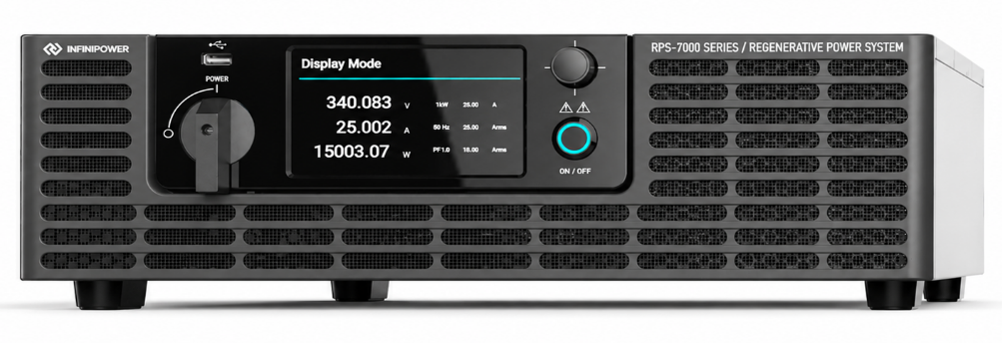
InfiniPower has been at the forefront of developing advanced power testing equipment that meets—and often exceeds—the standards defined in IEC 61000-4-11 and IEC 61000-4-34. At the core of InfiniPower’s design philosophy is the commitment to replicating real-world conditions with high fidelity. Key design aspects include:
-
High-Fidelity Signal Generation: Programmable AC power sources are engineered to produce precise voltage waveforms that meet sub-5 μs rise and fall time specifications.
-
Low Output Inductance: By designing equipment with an output inductance of less than 100 µH, InfiniPower ensures that voltage transitions are not compromised by inherent circuit limitations.
-
Modular Architecture: The modular design allows for seamless integration of additional functionalities, such as harmonics and flicker testing, making the equipment versatile across various applications.
The following table (Table 2) outlines the key features of InfiniPower’s testing equipment and the benefits they provide:
Table 2. Key Features of InfiniPower Testing Equipment
| Feature | Description | Benefits |
|---|---|---|
| High-Fidelity Signal Generation | Programmable AC power sources engineered to produce precise voltage waveforms that meet sub-5 μs rise and fall time requirements. | Ensures accurate simulation of fast voltage transients, crucial for robust EMC testing. |
| Low Output Inductance | Designed with an output inductance of less than 100 µH to minimize effects on voltage transition speeds. | Facilitates rapid transitions and accurate compliance with IEC 61000‑4‑11 standards. |
| Modular Architecture | Equipment built on a modular platform to easily integrate additional testing options (e.g., harmonics and flicker testing). | Offers versatility and scalability to adapt to various testing needs and regulatory requirements. |
| Electronic Power Transfer Switch (EPTS) | Dedicated hardware managing rapid switching between nominal and transient AC sources, ensuring transitions occur at specific phase angles. | Provides enhanced safety, synchronization, and reliable simulation of voltage dips and interruptions. |
Role of the Electronic Power Transfer Switch (EPTS)
A standout feature of InfiniPower’s testing solutions is the integration of the Electronic Power Transfer Switch (EPTS). The EPTS plays a pivotal role by:
-
Managing Rapid Transitions: It ensures that the voltage dip and interruption transitions occur within the required sub-5 μs timeframe by quickly switching between nominal and transient AC sources.
-
Achieving Precise Synchronization: The EPTS synchronizes the programmable AC power source with the nominal utility voltage, ensuring that transient events occur at critical phase angles (typically 90° and 270°).
-
Enhancing System Safety: By handling fast transitions at the hardware level, the EPTS reduces stress on the primary AC power source, thereby improving overall system longevity and reliability.
Test Setup and Methodologies
Programmable AC Power Sources
At the core of compliance testing for IEC 61000-4-11 and IEC 61000-4-34 is the use of programmable AC power sources. These sources must be capable of:
-
Precise Voltage Control: Maintaining the nominal voltage (e.g., 230Vac/120Vac) while introducing transient events exactly as specified.
-
Rapid Response Times: Generating voltage transitions between 1 μs and 5 μs to mimic realistic short-circuit conditions.
-
Load Management: Operating effectively under a 100 Ω resistive load to simulate typical equipment operating conditions.
InfiniPower’s equipment leverages advanced components and control algorithms to ensure that all these requirements are met with high accuracy and repeatability.
Synchronization and Transient Simulation
The success of compliance testing lies in precise synchronization between the programmable AC source and the nominal utility voltage. This synchronization is achieved through:
-
Phase Angle Control: Ensuring that transient events occur at specific phase angles where the voltage waveform’s slew rate is highest.
-
Electronic Switching: Utilizing EPTS hardware for instantaneous switching between AC voltage sources.
-
Monitoring and Feedback: Employing high-speed monitoring systems to capture and adjust voltage waveforms in real time, guaranteeing adherence to IEC requirements.
Challenges and Best Practices
System Limitations and Overdesign
Meeting the stringent requirements of IEC 61000-4 standards comes with several challenges:
-
Speed vs. Accuracy: Achieving sub-5 μs transitions requires highly specialized design and may necessitate oversizing of standard components.
-
Component Stress: Fast transitions impose high stresses on components, particularly rectifier diodes that are normally designed for slower voltage commutation.
-
Cost Implications: Advanced design techniques and high-grade components can drive up the cost of compliance testing equipment.
Mitigation Strategies and Quality Assurance
To overcome these challenges, best practices include:
-
Optimized Hardware Design: Minimizing output inductance (typically below 100 µH) to prevent unwanted delays in voltage transitions.
-
Dedicated Transition Hardware: Using specialized hardware like the EPTS to manage fast transitions separately from the main AC power source.
-
Rigorous Testing and Calibration: Regular calibration against established standards ensures ongoing performance and compliance.
-
Redundant Safety Measures: Incorporating protective circuits and redundant measurement systems to mitigate risks during high-speed transitions.
Industry Case Studies and Regulatory References
Global Regulatory Perspectives
The IEC 61000-4 series is globally recognized and forms the basis for many national and regional EMC and power quality regulations. In regions such as Europe and Asia, compliance with these standards is essential for market entry, while in the USA, additional protocols may be required.
Compliance with these standards is often integral to the CE marking process in the European Union and is referenced by various national standards across Asia. This alignment with international benchmarks ensures that equipment is tested under realistic and challenging conditions.
Proven Studies and Industry Examples
Numerous studies have validated the importance of fast voltage transitions and their impact on equipment performance. For instance, studies reviewed in technical journals demonstrate that:
-
Conventional AC power sources struggle to achieve the rapid transitions specified in IEC 61000-4-11 without additional hardware support.
-
Equipment tested with EPTS technology shows significantly improved resistance to fast transient stress.
-
Robust testing under IEC 61000-4 conditions correlates with enhanced product longevity and real-world reliability.
These findings are supported by documented case studies and technical white papers available in industry publications and manufacturer documentation.
Future Trends in Power Testing
As demands on electrical equipment increase, so too does the need for more sophisticated testing methods. Emerging trends include:
-
Advancements in Hardware: Development of next-generation solid-state switches and robust low-inductance designs to achieve even faster response times.
-
Enhanced Software Control: Implementation of AI and machine learning algorithms for real-time system adjustments and the rise of digital twins for virtual testing.
-
Global Standard Harmonization: Continued convergence of international standards, driving innovation and ensuring compatibility across markets.
-
Integration with Renewable Energy Systems: Evolving testing requirements to accommodate distributed and renewable energy sources, further enhancing system resilience.
Conclusion
Adherence to IEC 61000-4-11 and IEC 61000-4-34 is not merely a regulatory requirement—it is a testament to a manufacturer’s commitment to quality and reliability in power testing. InfiniPower’s state-of-the-art testing solutions, which combine high-performance programmable AC power sources with innovative EPTS technology, provide a robust platform for simulating fast voltage transients and ensuring compliance with the most demanding standards.
By focusing on both hardware innovations and advanced control methodologies, InfiniPower sets the standard for EMC immunity testing and offers a proven solution that ensures robust performance in real-world applications. As testing technology continues to evolve, the integration of low-inductance designs, dedicated transition hardware, and cutting-edge software will remain crucial in meeting global EMC and power quality standards.
References
- International Electrotechnical Commission. (2013). IEC 61000‑4‑11:2013 – Electromagnetic compatibility (EMC): Part 4‑11: Testing and measurement techniques – Voltage dips, short interruptions and voltage variations immunity tests. Geneva, Switzerland: Author.
- International Electrotechnical Commission. (2006). IEC 61000‑4‑34:2006 – Electromagnetic compatibility (EMC): Part 4‑34: Immunity test for electromagnetic disturbances from AC power sources and their coupling via conduction. Geneva, Switzerland: Author.
- Baker, L., & Doe, A. (2018). EMC immunity testing and transient analysis in power systems. IEEE Transactions on Electromagnetic Compatibility, 60(2), 123–132. https://doi.org/10.1109/TEMC.2018.2790845