Abstract
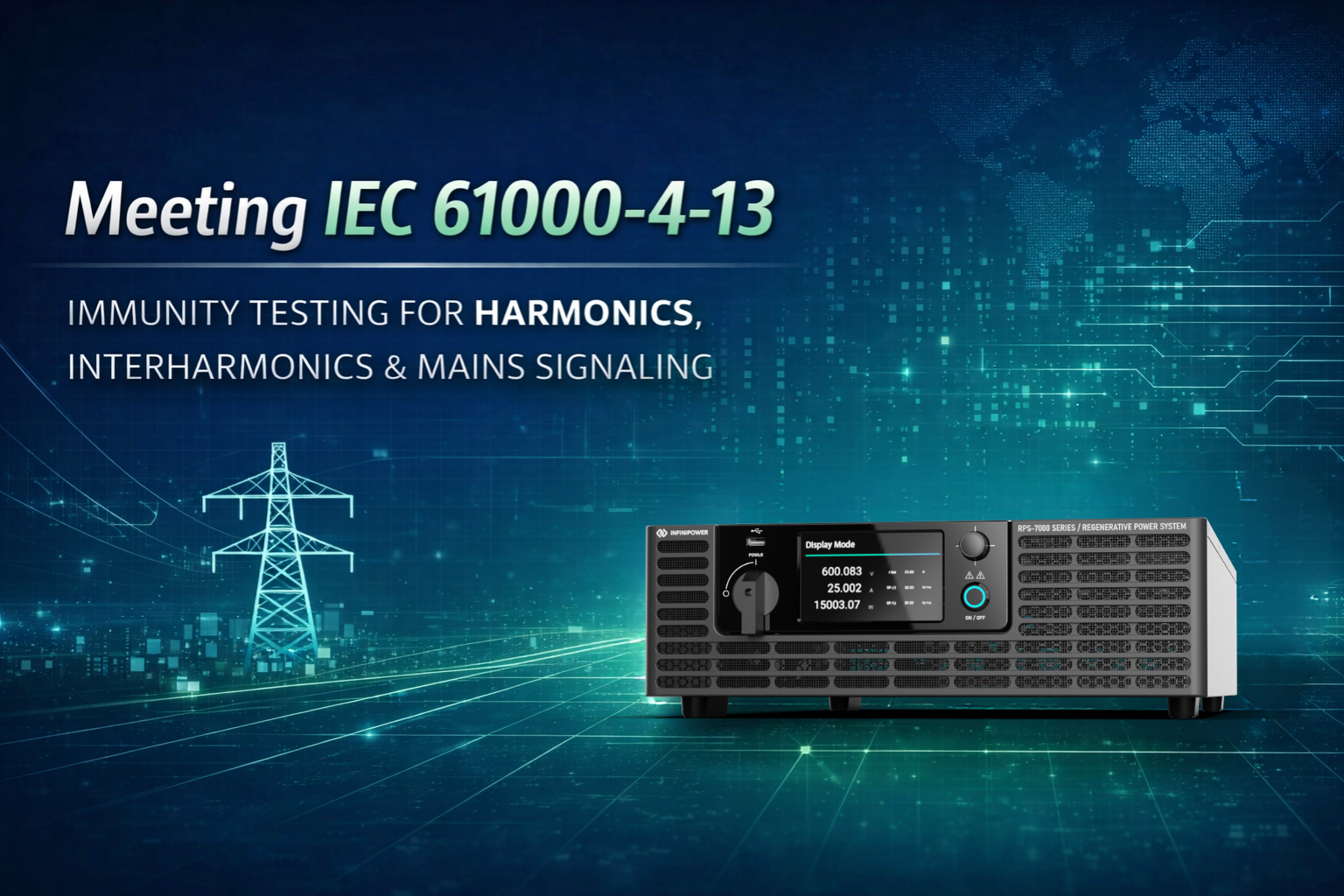
In the modern power electronics landscape, the public utility grid is no longer a pure 50Hz or 60Hz sine wave. With the proliferation of Switched-Mode Power Supplies (SMPS), variable frequency drives, and grid-tied renewable energy equipment, the grid is increasingly filled with various waveform distortions. IEC 61000-4-13 is the core international standard specifically designed to evaluate the low-frequency immunity of AC power ports. This article explores the threats posed by harmonics, interharmonics, and mains signaling to equipment. It also analyzes how engineers can utilize the INFINIPOWER RPS-5000 simulator—equipped with “four-quadrant simulation” and “energy recovery” capabilities—to precisely execute the complex verifications required by this regulation.
- Analyzing Physical Phenomena: What is Interfering with Your Grid?
IEC 61000-4-13 defines and simulates three types of low-frequency physical phenomena that typically cause changes in the waveform envelope, leading to operational instability:
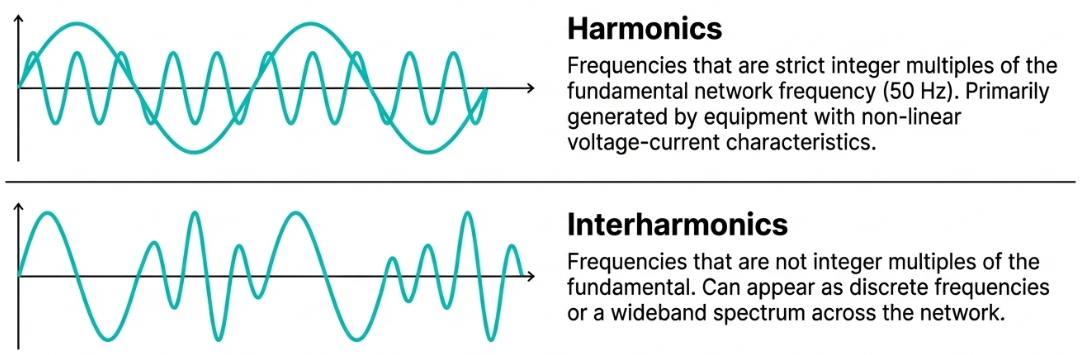
- Harmonics: Frequency components that are integer multiples of the fundamental frequency (e.g., 180Hz/3rd, 300Hz/5th). These primarily originate from the feedback of large numbers of non-linear loads, such as LED drivers and computer power supplies, drawing current discontinuously.
- Interharmonics: Frequency components that are non-integer multiples of the fundamental frequency. These distortions are commonly found in induction motor drives, induction heating equipment, or photovoltaic (PV) inverters. Their unpredictable nature makes them extremely difficult to filter out using traditional methods.
- Mains Signaling: Specific superimposed signals used by utility companies for remote equipment control or communication (typically between 110Hz and 3kHz). Testing equipment must verify whether the device under test (DUT) mistakenly interprets these signals as power interference, which could cause functional interruptions.
- Systemic Hazards: Why Compliance is the Foundation of Stability
If power electronic products lack immunity to IEC 61000-4-13, they may face the following high-cost risks even if they operate normally under standard voltages:
- Abnormal Heat Loss and Shortened Lifespan: High-order harmonics cause skin effects, leading to abnormal Joule heating in transformer coils, industrial motors, and power cables. Repeated waveform distortions also place cumulative stress on semiconductor components and electrolytic capacitors, significantly reducing the product’s Mean Time Between Failures (MTBF).
- Control Logic Failure: Severe waveform distortion interferes with “zero-crossing detection” circuits. This is critical for SCR-based or microcontroller control systems relying on precise phase control, potentially causing random MCU resets, control logic crashes, or unstable output.
- Communication Interference and Nuisance Tripping: Strong interharmonics can drown out valid Power Line Communication (PLC) signals or even trigger the nuisance tripping of Residual Current Devices (RCD) or overcurrent protectors, leading to unplanned downtime.
- Key Test Waveforms and Verification Goals
To realistically replicate an unstable grid environment, IEC 61000-4-13 defines several challenging test waveforms:
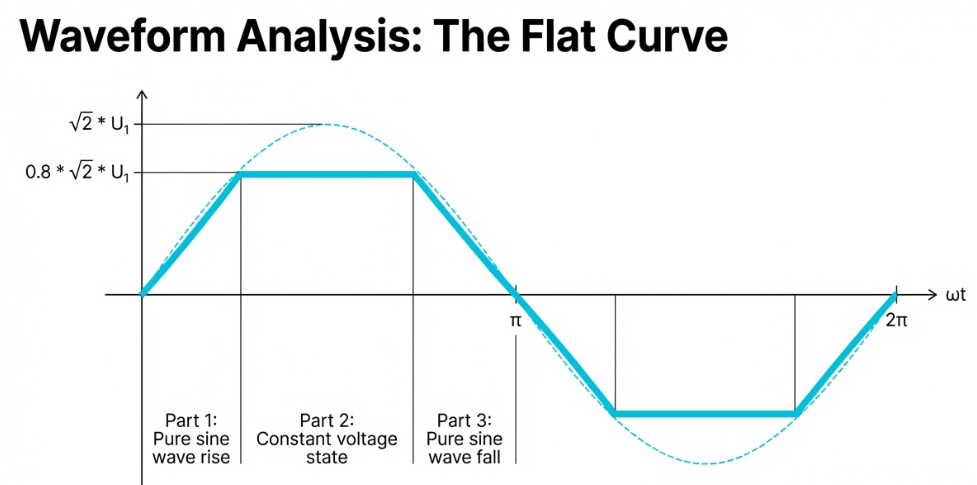
- Flat Curve: Simulates the waveform “clipping” effect caused by numerous rectifying loads charging simultaneously. This verifies the voltage maintenance capability and ripple suppression performance of the EUT’s internal DC Bus.
- Over Swing: Simulates transient overvoltages produced by capacitor switching or system resonance. This test directly challenges the insulation endurance and the energy absorption limits of overvoltage protection components (such as varistors).
- Frequency Sweep: Continuous spectrum injection ranging from 16Hz to 2.4kHz. This acts as a “hearing test” for electronic products, identifying whether internal filtering circuits generate destructive resonance at specific frequencies.
- Meister Curve: Specifically used for immunity testing against mains signaling. It verifies that the equipment maintains normal operation without misinterpretation when the utility company sends communication commands.
- Hardware Challenges for Testing Equipment: Key Technologies for Precision Simulation
According to regulatory requirements, an AC power simulator must overcome the following hardware hurdles to perform these tests:
- Ultra-Low Output Inductance: To simulate rapid switching transients with transition times between 1µs and 5µs, the output inductance must be below 100µH. Traditional power sources often have too much inductance, which distorts the injected harmonic waveforms and invalidates the test results.
- Asynchronous Frequency Synthesis: Since interharmonics are not aligned with the fundamental frequency, the equipment requires an independent Digital Signal Processing (DSP) engine to generate and perfectly superimpose multiple asynchronous waveforms simultaneously.
- Four-Quadrant and Back EMF Handling: When simulating a voltage dip with an inductive load (like a motor), the load generates Back Electromotive Force (Back EMF) feedback. If the testing equipment lacks Sink (energy absorption) capabilities, the output waveform will suffer severe distortion.
- INFINIPOWER Solution: The RPS-5000 Ultimate Compliance Platform
The INFINIPOWER RPS-5000 Series is engineered for complex grid simulation and is your ideal partner for R&D and certification:
- Comprehensive Software Support: Paired with the exclusive PowerVUE remote control software, it includes built-in automated test templates for IEC 61000-4-11, 13, 14, and 28. Engineers simply select the standard number, and the system automatically configures harmonic orders, phase angles, and interharmonic frequencies, drastically shortening the development cycle.
- SiC MOSFET Technology: Utilizing third-generation semiconductor technology, the system achieves microsecond-level High Slew Rates, ensuring the high fidelity of Over Swing and switching transients.
- Four-Quadrant Regenerative Function: The equipment features up to 90% energy recovery efficiency. During high-power, long-duration burn-in or immunity testing, it returns absorbed energy to the grid, saving electricity costs and reducing laboratory ambient temperatures.
- Ultra-Low Voltage High Current Simulation: Supports maintaining high current output at extremely low voltages, perfectly matching the dynamic test scenarios for AI server power supplies (VRM/POL).
Conclusion
Amid the rising trends of “Green Energy Interconnection” and “Distributed Power,” IEC 61000-4-13 verification has evolved from merely “obtaining a certificate” to “ensuring a product’s survival and competitiveness in a harsh global grid.” Through the high-precision simulation and automated workflows of the INFINIPOWER RPS-5000 Series, we assist you not only in achieving market certification but also in building a robust electrical immunity system for your products, supporting stable, efficient, and sustainable corporate growth.