From GB300 and ORv3 HPR V2 to Vera Rubin: The Real Challenges of Next-Generation AI Power Testing
Rapid advances in AI computing performance are redefining data-center power architectures. From the 5.5 kW PSU used in GB300 NVL72 to the 12 kW PSU of the new ORv3 HPR V2 and the 18.5 kW PSU of the Vera Rubin platform, the power of a single power module continues to increase. At the Power Shelf level, capacity has progressed from 33 kW to 72 kW and 110 kW, moving the entire AI power architecture toward substantially higher power density.
For power R&D and validation engineers, this is not merely a matter of needing a higher-power AC source. As power density rises and AI loads demand greater pulse current, the traditional practice of selecting a test source solely by its kVA rating no longer reflects actual test capability.
Two 135 kVA AC sources may appear to occupy the same power class on a specification sheet, yet under real AI server power-test conditions they can provide very different current coverage. The key question is not only how many kVA the AC source is rated for, but how much usable current each phase can actually deliver at the voltage and pulse conditions required by the DUT.
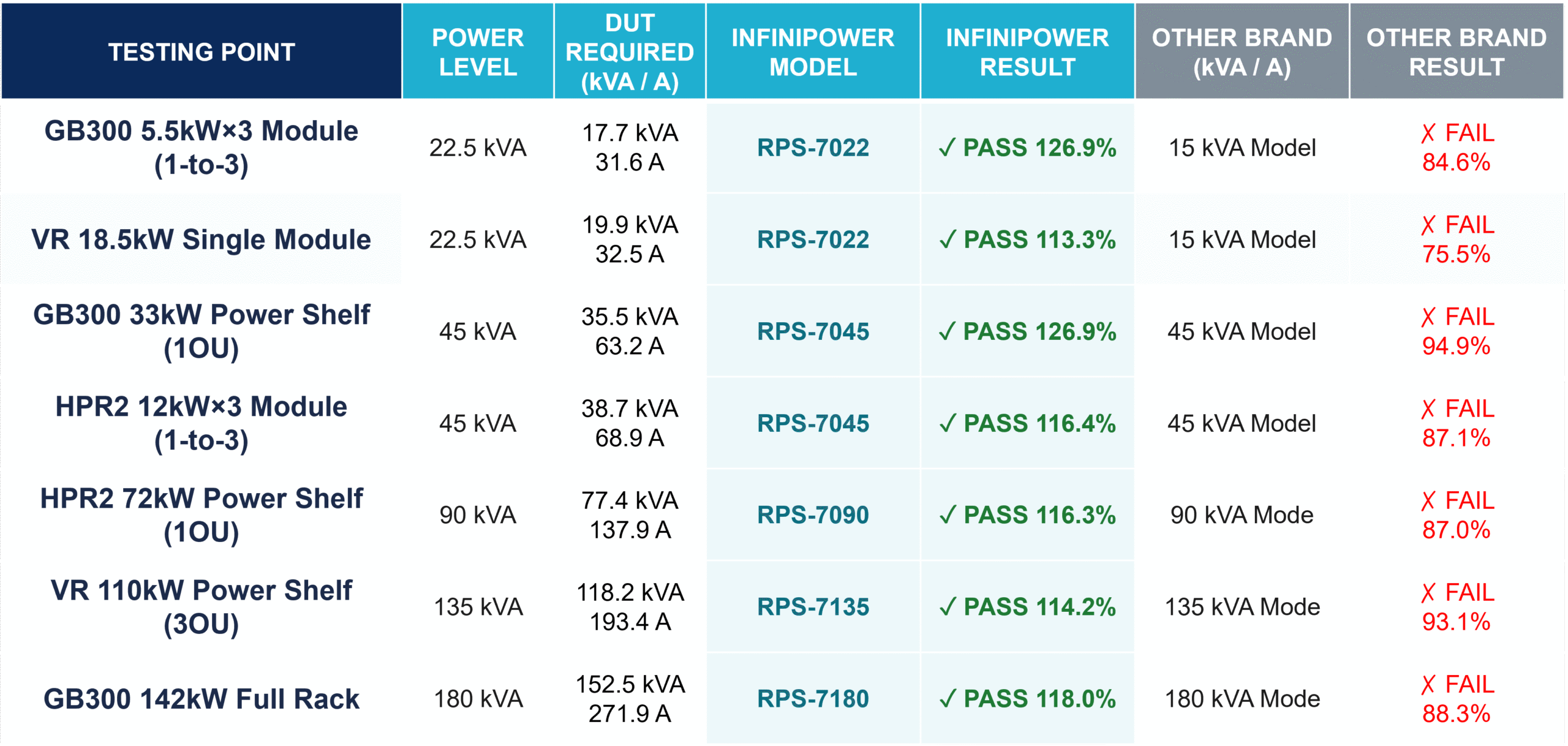
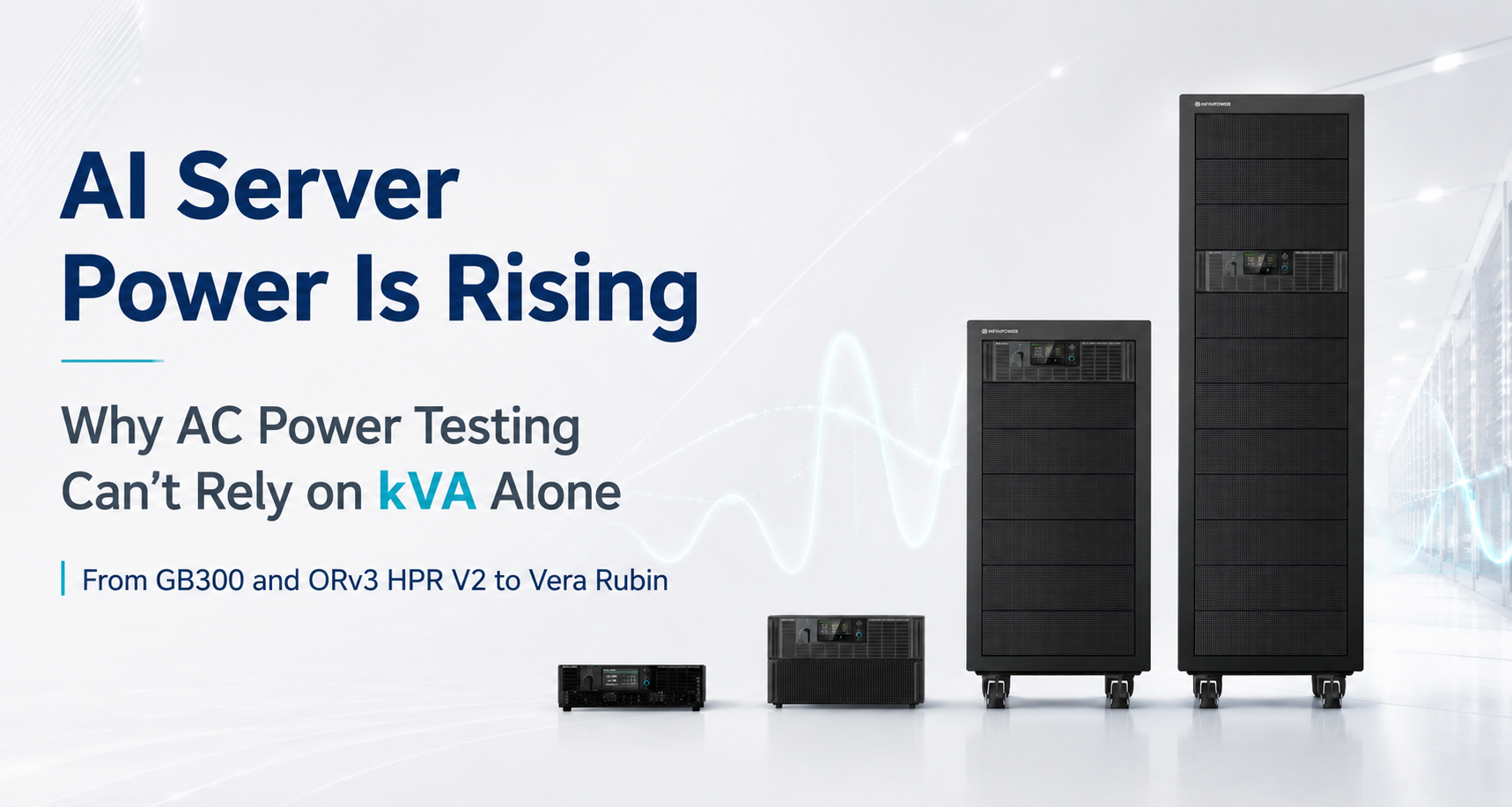
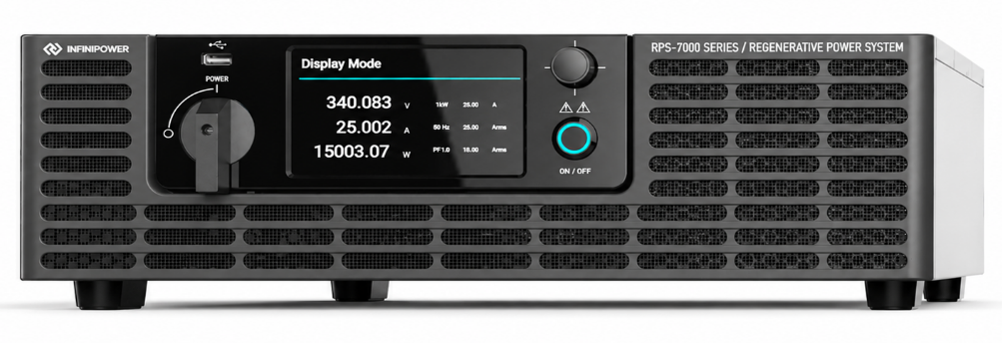
RPS-7000 Series: AI Power Testing Applications & Test Coverage
From 33 kW to 110 kW: AI Power Shelves Are Rapidly Moving Toward Higher Power Density
Looking across today’s major AI power architectures, the trend toward greater power density is unmistakable.
| AI Power Architecture | PSU Power | Power Shelf | System Power |
|---|---|---|---|
| GB300 NVL72 / ORv3 HPR | 5.5 kW | 33 kW / 1OU | Approx. 142 kW |
| ORv3 HPR V2 | 12 kW | 72 kW / 1OU | Up to 190 kW / 9OU |
| Vera Rubin NVL72 | 18.5 kW | 110 kW / 3OU | 440 kW |
The ORv3 HPR architecture associated with GB300 NVL72 uses 5.5 kW PSUs, with six PSUs forming a 33 kW / 1OU Power Shelf. ORv3 HPR V2 raises each module to 12 kW, allowing six modules to form a 72 kW Power Shelf within the same 1OU height—about 2.18 times the 33 kW level. With Vera Rubin NVL72, each PSU increases further to 18.5 kW; six modules form a 110 kW / 3OU Power Shelf, and a four-shelf system architecture can reach 440 kW.
This means an AC source must not only support a higher rated power, but also handle the current demand that rises with power density. In particular, when an AI Power Shelf enters pulse-test conditions, current capability becomes a selection criterion as important as kVA.
Highly Dynamic AI Loads: Pulse Current Becomes a New Test Threshold
AI server loads are highly dynamic. As GPUs switch rapidly between operating states, the Power Shelf must withstand large short-duration power changes. Test equipment must therefore do more than supply rated power; it must also validate PSU behavior under pulse loads.
Based on current test data, the pulse envelope for GB300 / ORv3 HPR includes 136% for 50 ms and 160% for 400 μs. Vera Rubin includes pulse conditions of 150% for 50 ms and 180% for 0.5 ms.
A 50 ms pulse cannot be supported solely by short-duration peak-current capability. Fifty milliseconds is approximately 2.5 cycles of a 50 Hz power waveform, so the AC source must have sufficient RMS current capability to truly cover this type of test condition.
In other words, the AI power-testing question has progressed from “Is the capacity sufficient?” to “Can the required current actually be delivered at the specified voltage and for the specified duration?”
Why Can AI Test Capability Differ at the Same kVA?
This is where differences between AC-source design architectures become visible in AI test applications. An AC source must balance output-voltage range, power, current, size, and system architecture. Consequently, two systems with the same rated kVA do not necessarily provide the same output current per phase.
At the 135 kVA power level, an INFINIPOWER RPS-7000 Series configuration can provide 135 kVA / 241 A per phase. By comparison, another 135 kVA AC-source configuration provides 180 A per phase. Their rated capacities are identical, but the difference in usable current is approximately 61 A per phase.
This is not simply a comparison of which AC source is “better.” It reflects different design priorities in the relationship between power and current. Under ordinary steady-state testing, the difference may not immediately become a limitation. Under the high pulse-current conditions required by an AI Power Shelf, however, it directly affects actual test coverage.
Therefore, for AI power testing, current density and current per phase deserve renewed attention alongside rated kVA.
72 kW Power Shelf: Same 135 kVA Rating, Different Real-World Test Coverage
Consider the 72 kW / 1OU Power Shelf in ORv3 HPR V2, where six 12 kW PSUs form one 72 kW Power Shelf. Under the currently adopted EDPP −15% design condition, the evaluation voltage is 187 V L-N, and the current required for a 150% continuous pulse reaches 206.8 A/phase.
Comparing this requirement against two 135 kVA AC-source configurations makes the difference clear:
| Comparison | INFINIPOWER RPS-7000 | Another 135 kVA Configuration |
|---|---|---|
| Rated Capacity | 135 kVA | 135 kVA |
| Usable Current per Phase | 241 A | 180 A |
| 150% Pulse Current Requirement | 206.8 A | 206.8 A |
| Pulse Current Coverage | Approx. 116% | Approx. 87% |
| Under This Test Condition | Covered by one system | Additional capacity or reconfiguration required |
Both systems have exactly the same rated capacity, but their available current capability under this AI power-test condition is different. The INFINIPOWER RPS-7000 provides 241 A/phase, covering the 206.8 A/phase requirement. If another configuration in the same power class provides 180 A/phase, additional system capacity or a revised configuration is needed to obtain the required current.
The same rated capacity therefore does not guarantee the same AI power-test coverage. When comparing AC sources, engineers must look beyond kVA and verify current per phase under the actual test conditions.
More kVA Does Not Necessarily Mean More Usable Power
In addition to output current per phase, test voltage is another essential factor.
An AC source’s rated kVA is generally valid within a specified output-voltage range. When the system is limited by maximum output current, the actual deliverable power begins to decrease once the test voltage falls below a critical point. This minimum full-power voltage can be expressed in simplified form as:
V_min = capacity per phase ÷ maximum current per phase
For AI server power testing, comparing only 90 kVA, 135 kVA, or 180 kVA ratings is therefore incomplete. Engineers must also determine whether the equipment can still deliver its full rated power at the minimum voltage actually required by the DUT.
The V_min of the INFINIPOWER RPS-7000 Series is 156 V. Therefore, the 187 V L-N condition used for GB300 / HPR V2 and the 203.7 V L-N EDPP −15% evaluation condition used for Vera Rubin both remain within the full-power output range.
Different AC-source architectures can have different V_min values. When the minimum full-power voltage is higher than the DUT’s actual test voltage, maximum output current may limit the usable capacity—even if the equipment has the same or a higher rated kVA.
A more complete selection logic for AI power testing is therefore: rated power → test voltage → available current → actual usable power, rather than rated kVA alone.
How Does High Current Density Change AI Power-Test System Configuration?
A key design characteristic of the INFINIPOWER RPS-7000 Series is its current density of approximately 2.13 A/kVA across multiple power levels. The value of high current density is not merely a larger current number on a datasheet; it directly affects how the test system must be configured.
When the current required by a Power Shelf exceeds the capability of a single AC source, a common solution is to increase system capacity or parallel multiple units. This can technically meet the test requirement, but it may also increase equipment count, rack-space demand, AC wiring, synchronization-control requirements, and overall system-integration complexity.
If an AC source can provide more output current per phase at the same or a similar kVA level, the same AI power-test requirement may be covered with a more streamlined system. Current density is therefore more than an electrical specification: it also affects equipment quantity, space allocation, and overall test-system complexity.
From Power Module to Power Shelf: How Does Current Capability Affect System Configuration?
The importance of current capability is not limited to a 72 kW Power Shelf. Across GB300, ORv3 HPR V2, and Vera Rubin, a single PSU has increased from 5.5 kW to 12 kW and 18.5 kW, while Power Shelves have progressed from 33 kW to 72 kW and 110 kW. As DUT power continues to rise, the test current required from each AC-source phase also increases.
Even when different test solutions have similar total kVA, differences in current density and low-voltage output capability can directly affect how many units are needed to obtain sufficient test current. For AI power testing, this again demonstrates that system evaluation cannot stop at rated kVA. Actual test voltage, usable current per phase, and pulse-current requirements must all be considered to determine true test coverage.
The Selection Logic for AI Power Testing Is Changing
In the past, engineers could start with the DUT power rating and add a margin to quickly estimate the required AC-source capacity. From GB300 and ORv3 HPR V2 to Vera Rubin, however, next-generation AI power architectures are simultaneously moving toward higher power density, higher pulse current, and greater current demand per phase.
Selecting an AI power-test system should therefore include all of the following, not just kVA:
- Power Capacity: Is the kVA rating sufficient for the DUT’s power requirement?
- Current per Phase: How much RMS current can each phase provide at the actual test voltage?
- Pulse Capability: Can the system cover the continuous and transient pulse conditions required by the DUT?
- Low-Voltage Full-Power Range: Can the system maintain full rated power when the test voltage is reduced?
- System Scalability: Can the system provide the required power and current through an appropriate configuration for different Module and Power Shelf power levels?
kVA remains important, but it should no longer be the only selection criterion for AI power testing.
Designed for Next-Generation AI Power Architectures
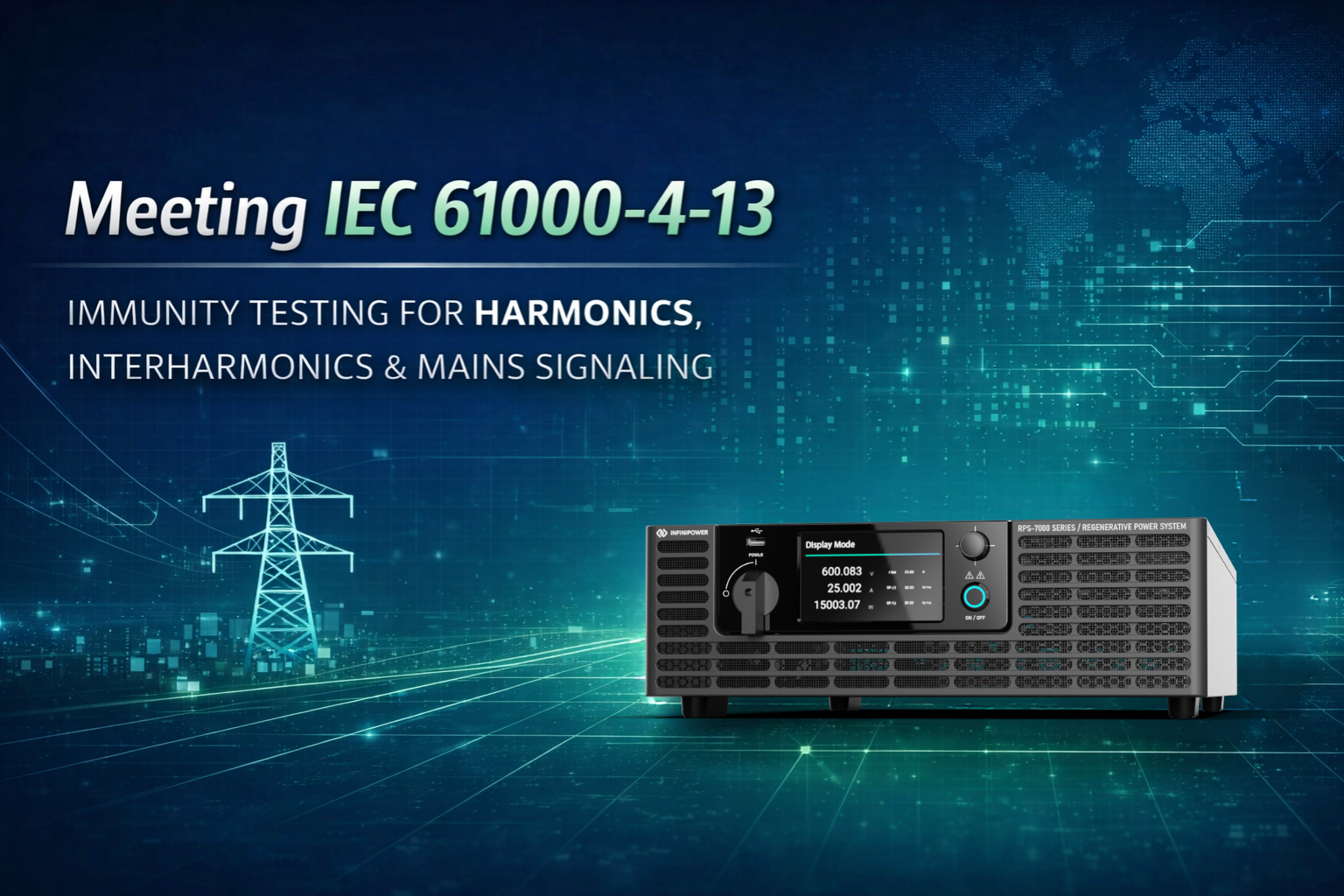
The INFINIPOWER RPS-7000 Series is designed around more than rated kVA. It integrates high current density, full-power output at low voltage, and pulse capability at the platform level. As the power and current requirements of AI Power Modules and Power Shelves continue to rise, the RPS-7000 Series provides more usable current per phase at the same or a similar kVA level, helping engineers cover real-world test conditions with a more streamlined system configuration.
For AI server power testing, the key question is no longer merely “How many kVA does this AC source have?” It is:
“At the actual test voltage and pulse conditions, how much truly usable power and current can it deliver?”
Learn more about the INFINIPOWER RPS-7000 Series:
https://www.infinipowertech.com/rps-7000/